
Which Telescope is Best for Me?
As you might imagine, there is no simple answer to the question, “Which telescope is best for me?” The first thing we ask anyone who is getting started is:
What do you want to do with the telescope?
Once that question is answered, the choices narrow quickly. With hundreds of telescope models on the market, thinning out the herd early is a good idea. After you determine what you want to do with a scope, the remaining factors usually come down to:
What features would you like the telescope to have?
What is your budget?
More often than not, the biggest or most expensive telescope is not the best choice for your goals. Ease of use, portability, and the ability to upgrade later are important, long-term considerations that will save you a lot of pain (literally and figuratively) as you get into the hobby.
This article walks through the process of choosing the right telescope by starting with your specific goals. Along the way, we explain some of the basic telescope terms, optical designs, mounts, and features—but always in the context of how they affect what you actually want to do.
Choosing a Telescope Based on Your Goals
The best telescope choice depends not only on what you want to do now, but also on what you think you may want to do in the future. Some observers are perfectly happy doing visual observing for years. Others discover an interest in astrophotography later on, which often requires different equipment.
Astrophotography in particular involves accessories and upgrades, and not all telescopes are equally adaptable. If you think you may want to grow into imaging later, it can make sense to choose a more flexible system upfront rather than replacing everything down the road.
Portability and simplicity are also important considerations. Large telescopes gather more light, but they are heavier and more cumbersome. Many observers experience a bout of “aperture fever,” only to find that an 80-pound telescope is less appealing at 2 a.m. than it looked on paper. A telescope that is easy to use and easy to transport is far more likely to see regular use.
Goal 1: I Just Want to Stargaze
This section is for the observer who simply wants to look. If your goal is to see the night sky with your own eyes—and not to take photographs, stack exposures, or connect a camera to a laptop—you are not alone. Many people start looking for a telescope imagining a classic, long, slender instrument pointed at the stars, only to find themselves overwhelmed by options designed primarily for astrophotography.
If that sounds familiar, this section is for you. This category focuses entirely on backyard stargazing: viewing the Moon, the planets, star clusters, nebulae, and distant galaxies—no cameras required.
What Matters Most for Stargazing
The diameter of the lens or mirror in a telescope—the aperture—is the single most important factor for stargazing. The bigger the aperture, the more light the telescope gathers. Ultimately this is the main purpose of a telescope: to gather as much light as possible and funnel it into your eye. Since the light-gathering ability of a telescope is determined by the area of the lens or mirror, doubling the aperture quadruples the light-gathering ability. A small difference in aperture makes a big difference in what you see. A look at the picture below shows the difference between the area of an 8" telescope mirror and the typical 7mm opening of the human eye.
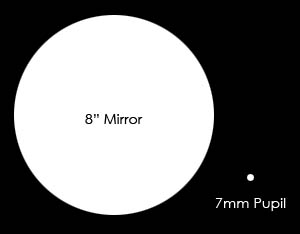
Above: Comparison of the relative areas (and light-gathering ability) of an 8" mirror and the human eye.
Doubling the aperture quadruples the light-gathering ability, so even small increases in size make a noticeable difference. An 8" telescope gathers more than 800 times as much light as the unaided eye.
Bottom line: When choosing a telescope for stargazing, buy as much aperture as you can reasonably afford and comfortably use.
For visual observing, factors like focal length and focal ratio play a much smaller role than aperture and are not usually deciding factors when choosing a first stargazing telescope. In many cases, manufacturers offer the same telescope aperture in different focal lengths. In smaller-sized telescopes, it is often better to choose the longer-focal-length version, as these designs tend to be easier to make well and still remain a manageable size. In larger apertures, very long focal lengths quickly become impractical, so shorter focal length designs are more common and make better sense. These terms become more relevant for specialized applications and are introduced later where they actually matter.
Recommended Telescope Types for Stargazing
Newtonian reflectors, including Dobsonians, offer the most aperture for the money. They do not suffer from chromatic aberration, have excellent optical performance, and are ideal for deep-sky observing. Their main drawback is that they are not suited to terrestrial viewing and require occasional optical alignment. For more detail, review our Newtonian and Dobsonian articles.
Schmidt-Cassegrain telescopes (SCTs) are more compact and portable while still offering good aperture. They are versatile instruments that perform well on planets and deep-sky objects. Another benefit of SCTs is that they allow for future upgrades. For more detail, review our Schmidt-Cassegrains article.
Mounts for Stargazing
For visual observing, alt-azimuth mounts are the most convenient and intuitive. Alt-azimuth mounts move up-down and left-right, making them very intuitive to use. However, an alt-azimuth mount must be computerized to track, since the rate of tracking varies across the sky in this orientation. Many telescopes are computerized and an alt-azimuth mount makes sense for many observers because of its convenience. Setting up an alt-azimuth mount is extremely easy compared to an equatorial mount. Equatorial mounts are not required for visual observing unless future photography is planned. Dobsonian telescopes are alt-azimuth mounted Newtonian telescopes. This design is very popular thanks to its ease of use and large aperture for the price. Dobs are among the best choice for beginners. While they do not always have automatic tracking, they are extremely simple to operate.
Goal 2: I Want Day and Night Viewing
If you want to observe wildlife, landscapes, or other terrestrial objects in addition to the night sky, your telescope choices narrow. Daytime viewing requires a telescope that produces a correctly oriented (upright) image. This immediately rules out Newtonian reflectors, which produce an inverted view.
Recommended Telescope Types for Day/Night Use
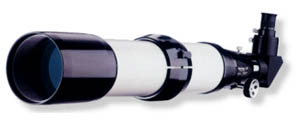
Refractors use lenses and are easy to use, easy to maintain, and well suited to terrestrial viewing. Inexpensive achromatic refractors are popular for daytime and casual nighttime use, while high-quality apochromatic refractors offer exceptional image quality at a much higher price. For more details on refractors, see our Refractor article.
Schmidt-Cassegrain and Maksutov-Cassegrain telescopes also produce upright images and are compact and portable. They tend to have narrower fields of view than refractors and excel at planetary observing.
If your priority is terrestrial viewing, and you might only occasionally look up at the stars, a small refractor or Cassegrain on an alt-azimuth mount is ideal. As soon as your priorities favor stargazing over birdwatching, it is better to have more aperture and a tracking mount. An alt-azimuth configuration is still recommended, so a computerized SCT is a good choice. In smaller sizes (6" or less) these are still highly portable.
Aperture, Focal Length, and Focal Ratio in Context
For combined day and night use, aperture remains important for astronomy, while longer focal lengths favor planets and distant terrestrial targets. Focal ratio remains a minor consideration for visual-only observing.
Mounts for Day/Night Observing
Since we are still in the realm of visual observing, Alt-azimuth mounts are strongly recommended for this category due to their ease of use and quick setup.
Goal 3: I Want to Do Astrophotography
Astrophotography places very different demands on a telescope system. Many excellent visual telescopes are poorly suited to imaging.
What Matters Most for Astrophotography
For photography, the mount is often more important than the telescope itself. For deep-sky imaging, an equatorial mount is required to accurately track the sky as Earth rotates.
While the mount normally needs to be an equatorial for deep-sky imaging, an alt-azimuth computerized SCT is still a popular choice for getting started since it can be converted to an equatorial mount when needed. Other designs work as well, such as Newtonians, Ritchey-Chrétiens, and other sophisticated optical designs, but for beginners, SCTs are hard to beat since they are good at a little of everything.
Focal ratio is also critical for photography. Faster systems (lower f-numbers) collect light more quickly, reducing exposure times. For imaging, focal ratio is often more important than aperture. Focal ratio is very important photographically because it determines how quickly a picture can be taken. For this reason, smaller focal ratios are called faster, while larger focal ratios are termed slower. Thus an f/5 telescope is faster than an f/10 telescope. However, accessories can be added that will bring that focal ratio down, like a reducer. Part of the reason for the popularity of SCTs is the ease with which they can be converted from f/10 to f/6.3 to even f/1.8 for certain models, making them ideal for a variety of applications.
Focal length determines the field of view. Long focal lengths are used for small objects like galaxies, while short focal lengths are preferred for wide-field subjects such as nebulae. For photography, focal length determines magnification. The longer the focal length, the greater the magnification and the smaller the field of view. This is why long-focal-length telescopes such as SCTs are used for imaging small objects like galaxies, while short-focal-length telescopes such as small refractors are used for wide-field imaging of large subjects like nebulae.
Recommended Telescope Types for Astrophotography
Apochromatic refractors provide the highest image quality and are excellent wide-field imaging instruments, though they are expensive. Keep in mind that only apochromatic refractors work for astrophotography, since the inexpensive achromatic models will have color aberrations that will significantly degrade the image.
Schmidt-Cassegrain telescopes are extremely versatile and can be adapted to a wide range of focal lengths and photographic applications, making them popular with beginners who want flexibility. For example, if you think you might want to add a HyperStar to your imaging train someday, SCTs are the way to go!
Other designs can work as well, but SCTs and apochromatic refractors remain the most common entry points into astrophotography.
Want the Easiest Possible Option? Consider a Smart Scope.
n recent years, a new category of telescope has emerged that is especially appealing to beginners: smart scopes. These telescopes combine optics, mount, camera, and software into a single, highly automated system designed to make observing as simple as possible. Setup is typically quick, alignment is automatic, and objects are selected through a smartphone or tablet.
One of the biggest advantages of a smart scope is live stacking. Instead of looking through an eyepiece, the telescope continuously captures and stacks images in real time, allowing you to watch faint objects gradually appear on the screen. Even for someone who considers themselves a visual observer, this can be a rewarding way to see nebulae and galaxies that are difficult or impossible to see with the naked eye from light-polluted locations—all without the complexity of traditional astrophotography equipment.
Popular examples include the ZWO SeeStar, and it is likely that many more options in this category will continue to appear. Smart scopes are not generally designed to be upgraded or expanded, but they are excellent for casual hobbyists, outreach, travel, or as a low-friction entry point into astronomy.
Planning for the Future
If you think you may want to expand into astrophotography or more advanced observing later, choose equipment that allows for growth. Mounts tend to outlast optical tubes, and SCTs offer some of the most flexible upgrade paths. Dobsonians, while excellent visual instruments, are best viewed as dedicated stargazing telescopes.
Choosing a telescope that fits your goals, budget, and lifestyle will ensure that it gets used—and that you’ll continue enjoying the night sky for years to come.