
Schmidt-Cassegrains
Schmidt-Cassegrains
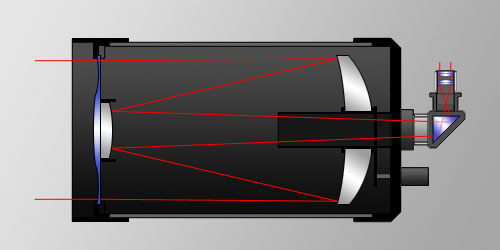
Above: Optical layout of a typical Schmidt-Cassegrain
Schmidt-Cassegrains telescopes (SCTs) have become one of the most popular types of telescopes. This is due to the versatility and compactness of the optical design. SCTs are only about twice as long as their aperture, making them highly portable. They are also well-suited to a number of applications including photography and terrestrial observing, as well as stargazing. Most new SCTs are computerized, adding to their ease of use and portability.
How Schmidt-Cassegrains Work
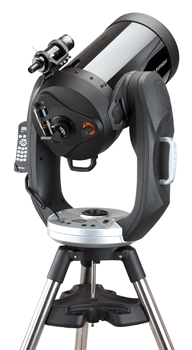
Schmidt-Cassegrain telescopes are a catadioptric design, meaning they use both lenses and mirrors. SCTs are primarily reflecting telescopes, but they use a corrector lens to eliminate aberrations that would result from the mirror design alone. In an SCT the incoming light passes through the Schmidt corrector lens (also called a corrector plate) at the front of telescope. It is reflected from a concave primary mirror at the back of the scope which focuses the light to the front of the telescope where it is reflected again by a smaller, convex secondary mirror. Finally, the light travels back through a hole in the primary mirror to the rear of the scope where an eyepiece is located for visual observing (or a camera for photographing). By folding the light in this manner, an SCT can be made much smaller than an equivalent Newtonian or refractor.
At first it seems that an SCT should have a focal length twice as long as the length of the tube, since the light travels twice the length of the tube. However, SCTs actually have focal lengths about 5 times longer than the tube length. This is due to the convex curvature of the secondary mirror. This effectively magnifies the focal length, making the scope act much longer than it is. The diagram below shows how a Cassegrain type telescope (such as an SCT or similar design) works to increase the effective focal length. The primary mirror of an SCT usually has a focal length only about twice its diameter. For example, an 8" telescope would have a primary mirror focal length of about 16". This focuses the light to a point 16" in front of the mirror. By placing a convex secondary mirror between the primary mirror and this focal point, the light is reflected back toward the primary mirror but at a less steep angle. If you trace this light cone back to where it reaches the full width of the telescope's aperture, you can see how long the effective focal length is. Most SCTs have secondary mirrors that provide a 5x magnification factor. In this example that would make the effective focal length 80", or ten times the diameter of the primary mirror, in a telescope only about 16" long.
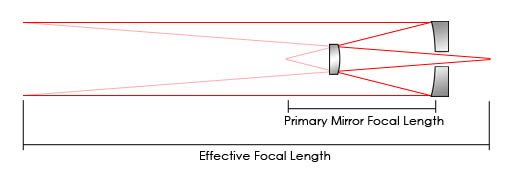
Above: How a Cassegrain telescope creates a long effective focal length in a short tube. The actual length of the telescope is barely longer than the separation between the two mirrors.
Varieties of Cassegrain Telescopes
So what makes a Schmidt-Cassegrain different from a Maksutov-Cassegrain, or just a plain old Cassegrain? The answer has to do with the corrector lens at the front of the scope. In an all-reflective Cassegrain telescopes (usually called a Classical Cassegrain), there is no corrector lens. To eliminate aberrations, this type of telescope must have aspherical mirrors, which are difficult and expensive to manufacture. By placing a corrector lens in front of the telescope, these aberrations can be minimized or eliminated while using spherical mirrors which are cheaper and easier to make. As the name implies, Schmidt-Cassegrains use a Schmidt corrector lens, while a Maksutov-Cassegrain uses a Maksutov corrector lens.
Schmidt corrector lenses have an aspherical shape. The curve on the lens is very slight, and the glass looks perfectly flat to the eye. The curve is drawn greatly exaggerated in the diagram at the top of the page.
With both mirrors left spherical, an SCT suffers from coma, an aberration affecting sharpness of the stars at the edge of the field. By making the secondary mirror aspheric, coma can be eliminated. Meade's Advanced Ritchey-Chrétien telescopes are of this latter design, simulating the effect of true Ritchey-Chrétien optics in an SCT configuration.
The Popularity of Schmidt-Cassegrains
Why are SCTs so popular? One word: versatility. Most amateur astronomers enjoy many different aspects of our hobby, from observing planets to hunting for deep-sky objects to photographing the heavens. SCTs are good for all of these things. While certain telescopes might be better suited for one particular application, SCTs can do it all. For the money, a Dobsonian will provide more aperture and hence be better for deep-sky observing, but it cannot be used for photography. A high-quality refractor can give some of the best planetary views of any type of telescope, but a large-aperture refractor capable of competing with an 8" or 10" SCT in light-gathering ability is a huge, painfully expensive telescope. SCTs combine a compact telescope with good moderate-aperture optics which are well-suited to visual observing and imaging.
Goto SCTs
Many modern Schmidt-Cassegrain telescopes are sold on computerized GoTo mounts, though manual versions and alt-az mounts paired with digital setting circles remain available at lower price points. SCTs are typically the flagship models of a manufacturer's product line and usually incorporate state-of-the-art technology. Goto mounts also lend themselves to compact design and add to the portability of SCTs.
Is a Schmidt-Cassegrain Best for Me?
For observers who want to be able to do a little of everything, from observing to photographing, SCTs are a great all-around telescope. They are very portable (at least in 11" and smaller sizes), and easy to setup and use. They often have the latest and greatest features in terms of computer systems and other high-tech gadgetry. If your only interest is in visual observing, you can get a larger-aperture Dobsonian for the price. But most observers have varied interests and that makes the Schmidt-Cassegrain a very popular choice.
For more information on what telescope might be best for you, check out our "Which Telescope is Best for Me?" article for details on the pros and cons of each type, relative to your personal astronomy goals.