
Dobsonians
Dobsonians
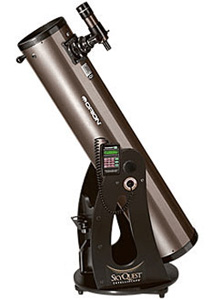
Above: Typical Dobsonian telescope
A Dobsonian telescope (Dob for short) is optically identical to a Newtonian telescope; the difference is in how the telescope is mounted. A Dobsonian has a lazy-Susan type base that swivels left and right, and the telescope rides on two hubs that allow motion up and down. Traditionally, Dobsonians were purely manual mounts with no gears or locks on either axis, relying instead on careful balance and smooth bearing surfaces. Today, the term ‘Dobsonian’ is also commonly used for designs that preserve this simple alt-az form while incorporating modern aids such as clutches, encoders, or motors.
A well-designed Dobsonian will move easily in each direction but will stay put when needed. Dobsonians are the least expensive type of telescope, for a given size. That fact and their ease of use make them a very popular design for both beginners and advanced observers. Because Dobsonians are alt-az mounted, they are generally not well suited to long-exposure deep-sky astrophotography. However, many observers do use Dobsonians for lunar and planetary imaging, as well as electronically assisted astronomy (EAA), where long exposures are not required. Primarily, they are an excellent choice for visual observing.
How a Dobsonian Works
Optically, a Dobsonian works exactly the same way a Newtonian does. (In fact, it is a Newtonian, just with a different type of mount.) Light is reflected off a primary mirror at the bottom of the telescope, to a smaller secondary mirror at the top of the telescope, and out the side of the tube to the eyepiece. The mount is what makes a Dobsonian unique. A Dob base is elegantly simple. No knobs, levers, switches, gears, handles, dials, or anything. Everything is moved by hand and in an altitude-azimuth, or alt-az (up-down/left-right) configuration. Pointing a Dob to any celestial object is easy.
This makes Dobs ideal for beginners because they have very gentle learning curves. A Dobsonian base usually incorporates Teflon or some similar material to allow the scope to move easily. Many modern Dobsonians also incorporate adjustable tension systems or hybrid bearing designs to help maintain smooth motion while accommodating a range of accessories. The perfect balance must be found between too easy and too difficult a movement. The best Dobsonians have incredibly smooth action but will not drift accidentally when the scope must stay put.
The Popularity of Dobsonians
Dobsonians are popular for two main reasons. For one, they offer the most bang for your buck. They are very inexpensive to build, so a larger aperture telescope can be had for a very reasonable price. This also means that for advanced observers, it is possible to own an extremely large telescope. Large Dobsonians offer incredible views of deep sky objects. The other reason for the popularity of Dobs is that they are extremely easy to use. This makes them ideal for beginners because someone can get a powerful telescope for little money and be out using it right away without having to spend a lot of time learning the intricacies of the telescope.
How Portable Are Dobsonians?
More portable than people first think. Most newcomers to the astronomy hobby do not expect a telescope to look like a Dobsonian! Everyone expects a refractor because that's Hollywood's idea of what a telescope should be. (Marvin the Martian wasn't using a Dobsonian to aim his Explosive Space Modulator at Earth in those Looney Tunes cartoons, after all.)
One of the comments most people make upon seeing a Dobsonian in person and being told that it is an ideal beginner's scope is that it looks too big to move around. On the contrary, Dobsonians are often one of the easiest telescopes to move around and set up. Since it basically consists of a hollow tube, the telescope itself is very light (at least in 10" and smaller sizes), and the base rarely weighs much more than the tube. Since there are only two parts to set up, and since it is not required to balance the telescope and polar align it (as would be the case with an equatorially mounted telescope), a Dob can be set up and ready to go in literally two minutes.
Larger Dobsonians present a bit more of a problem. Dobsonians come in two basic varieties, solid tube and truss tube. Solid tube Dobs look like the scope pictured at the top of this page. These are the easiest to set up, but in sizes larger than about 10" in aperture they become very heavy and too large to fit into most vehicles. Most people consider 12" to be the largest solid-tube Dob that is reasonably portable, although the physiologically gifted (read: muscle-bound) SUV owners among us may be able to tote around a 16" solid tube if they're feeling particularly motivated. For the rest of us, 14" and larger Dobsonians are often designed as truss-tube Dobs, seen in the picture below.
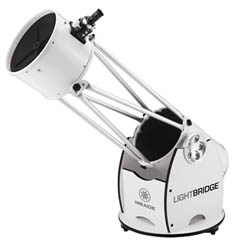
Above: A typical truss tube Dobsonian
The advantage of a truss-tube Dob is that the upper part of the telescope—called the upper cage—housing the secondary mirror and focuser, can easily be removed. The truss poles (numbering from two to eight, depending mostly on the size of the scope) are then removed, leaving only the compact base. The base consists of the mirror box (housing the primary mirror) and the rocker box, which holds the mirror box and allows the scope to rotate and tilt. Usually the mirror box and rocker box are transported as one unit. With a truss-tube design, a very large telescope can be made to fit into a pretty modest vehicle. The very largest telescopes (24" and up) often require a separate trailer, but are nonetheless portable telescopes that can often be assembled and ready for viewing in less than 30 minutes.
Computerizing Dobsonians
Dobsonian telescopes can usually be computerized. Most large-aperture (14"+) Dobs are computerized because finding objects with such a large scope can be tricky, especially if you have to climb a ladder to get to the eyepiece. Some smaller Dobs can be computerized very easily and inexpensively, and this is a popular option. Dobsonian telescopes can be equipped with a range of computer assistance, from digital setting circles (often called ‘push-to’) to fully motorized GoTo and tracking systems. While GoTo Dobsonians were once limited primarily to very large instruments, they are now commonly available in smaller apertures as well. These systems can automatically locate objects and, in many cases, track them once found, while still retaining the basic Dobsonian form.
Dobsonian Tracking
Similar to making a telescope goto, putting automatic tracking on a small Dobsonian is often impractical because of the associated costs. An equatorially mounted Newtonian would cost about the same price and would allow photography whereas a tracking Dob might not (depending on the design of the tracking system). However, on large telescopes, tracking becomes more essential and more cost effective relative to the original price of the scope, so tracking is often seen as on option on big Dobs. Most large Dobs use equatorial plaforms to track. These are platforms onto which the telescope is set. The platform has a polar axis which is aligned with Earth's rotation axis and allows tracking for a short amount of time (usually about an hour) before the platform must be reset. Since the telescope is just resting atop the flat platform, longer periods of tracking are precluded by the possibility of the scope tipping over off the platform (which would really ruin your night).
Is a Dobsonian Right for Me?
If you are mostly interested in visual observing, a Dobsonian is hard to beat. It is not as versatile as a Schmidt-Cassegrain or refractor (they cannot be used for terrestrial viewing), and they are not suited to photography (as an equatorially-mounted Newtonian or SCT would be), but neither are they as expensive. For someone looking for a telescope strictly for stargazing, Dobsonians are ideal. Their price and ease of use makes them ideal for beginners, and advanced observers stricken with a case of "aperture fever" find them hard to resist.
For more information on what telescope might be best for you, check out our "Which Telescope is Best for Me?" article for details on the pros and cons of each type, relative to your personal astronomy goals.