
Ritchey-Chrétiens
Ritchey-Chrétiens
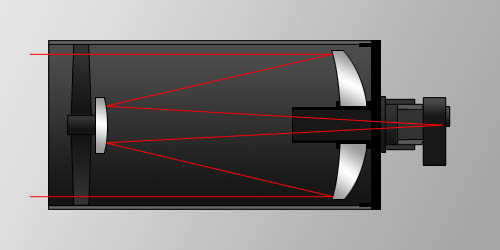
Above: Optical layout of a typical Ritchey-Chrétien, with CCD camera attached
Ritchey-Chrétiens have become popular in recent years for deep-sky imaging. They are intended primarily as photographic instruments and are not as well-suited to visual observing, but for imaging smaller deep-sky objects such as galaxies and small nebulae, they are hard to beat. Ritchey-Chrétien is commonly abbreviated RC.
How Ritchey-Chrétiens Work
RCs are a type of Cassegrain telescope, meaning they use a folded optical design like the more familiar Schmidt-Cassegrain telescopes (SCTs). However, they are an all-reflective system, using only mirrors and no lenses. Instead of the mirror being supported on the corrector lens as it is in a catadioptric design like an SCT, the mirror is supported by a spider consisting of four metal vanes. These produce the common diffraction spikes seen as crosses on bright stars in many astrophotos. Because of the folded optical design, RCs provide a long focal length in a short package. This high magnification makes them ideal for imaging small targets.
Aberrations in Ritchey-Chrétiens
In a classical Cassegrain telescope (another all-reflective design like the RC), the primary mirror at the back of the telescope has a parabolicshape, just like the primary mirror in a Newtonian. And like a Newtonian, classical Cassegrains suffer from off-axis coma, which prevents the stars at the edge of the field from being sharp.

Above: Shape of an off-axis star affected by coma. The center of the field is down in this diagram.
For professional astronomers, this is a problem because they need to be able to accurately measure the position of stars across the entire field of view. Coma is an asymmetrical aberration, and displaces the star images from their actual positions. The RC design trades off coma forastigmatism. The RC uses hyperbolic primary and secondary mirrors to eliminate coma and spherical aberration. However, the stars are still elongated at the edge of the field, but they are no longer asymmetrical as they would be with coma. This is critical for making astrometric measurements, and many professional telescopes, from Hubble to Keck, are Ritchey-Chrétiens.

Above: Shape of an off-axis star affected by astigmatism
For amateur astronomers who are interested only in pretty pictures, whether the telescope suffers from coma or astigmatism is less important. For advanced amateurs engaged in scientific study such as searching for or studying asteroids, an RC would be preferable. But for imaging deep-sky objects, coma versus astigmatism is more of a toss-up. A classical Cassegrain gives star images only about 10% larger than those of an RC at the edge of the field. So why are RCs so popular while classical Cassegrains tend to be rarer? One reason is that these are expensive telescopes, normally used by advanced amateurs, many of whom are doing scientific studies with them. But more often, the users are astrophotographers who are taking beautiful images of the night sky. Most commercial classical Cassegrains are designed as planetary telescopes and have very slow focal ratios (around f/15 or f/20). This makes them poorly suited to deep-sky imaging because of the longer time required to capture the light from a faint object. RCs on the other hand, have focal ratios in the range of f/7 to f/9, making them preferable for deep-sky photography. There is no reason an f/7 classical Cassegrain could not be built (and certainly some have been), but very few such commercial models exist, so RCs have become more popular. Ritchey-Chrétiens also suffer from field curvature. Field curvature distorts the star images across the field of view. This is because field curvature produces a curved focal plane. The outer parts of the focal plane are focused closer to the telescope than the inner parts (in an RC or other Cassegrain). But the detector used for imaging (whether a CCD or film) is flat, meaning the entire field cannot be in focus at once. RCs and classical Cassegrains have very comparable amounts of field curvature. But the curvature is almost 7 times greater than in a comparable Newtonian and about twice that of a comparable SCT. To use a very large imaging detector such as a 35mm format CCD, a field flattener lens is required. This lens provides a flatter field and can also minimize astigmatism to produce excellent star images across the entire field of view. These are common accessories for RCs.
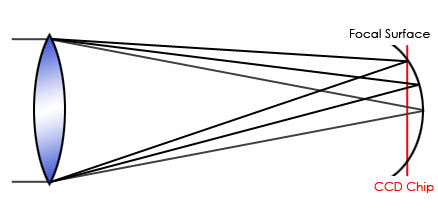
Above: A curved focal plane cannot focus sharp star images across the full field of a flat CCD chip
Is a Ritchey-Chrétien Best for Me?
Odds are, if it is, you'll already know, since these scopes are intended for advanced observers who have decided that high-resolution CCD imaging is their primary goal. But, RCs are not the only choice for advanced CCD imagers, so how do you know if you should get an RC versus a large apochromatic refractor or some sort of high-speed astrograph? It depends primarily on what you want to image. RCs are designed for high-magnification imaging of small targets. Most imagers who own an RC also own a small apo refractor for wide-field imaging. These two types of telescopes perfectly compliment each other. A more specialized telescope like a wide-field astrograph might be good if you have a preference for imaging only large objects such as nebulas and big galaxies. But an RC has a bit more versatility. An RC can be used with a focal reducer to allow a wider field of view, and with new large-format CCD cameras an RC can be used for small targets as well as all but the very largest objects.
For more information on what telescope might be best for you, check out our "Which Telescope is Best for Me?" article for details on the pros and cons of each type, relative to your personal astronomy goals.