
HyperStar Backfocus Requirements
As with most telescopes for imaging, and especially fast optical systems, the backfocus of the HyperStar lens is critical to getting the best performance. Backfocus is the correct distance between the HyperStar and the camera sensor that allows the HyperStar optics to perform as designed and produce a sharp image. Unlike focus (see article, Achieving Focus), which is adjusted by moving the telescope's primary mirror, backfocus remains fixed and does not change during use.
This article explains how HyperStar’s backfocus is measured, why it matters at HyperStar's fast f/2 focal ratio, the backfocus specifications for each model, and how the correct camera adapter provides the proper spacing.
Measuring HyperStar Backfocus
Backfocus is measured from the base of the male threads on the top of the HyperStar, where the camera adapter attaches to the camera sensor. It is not measured from the top of the HyperStar lens housing:
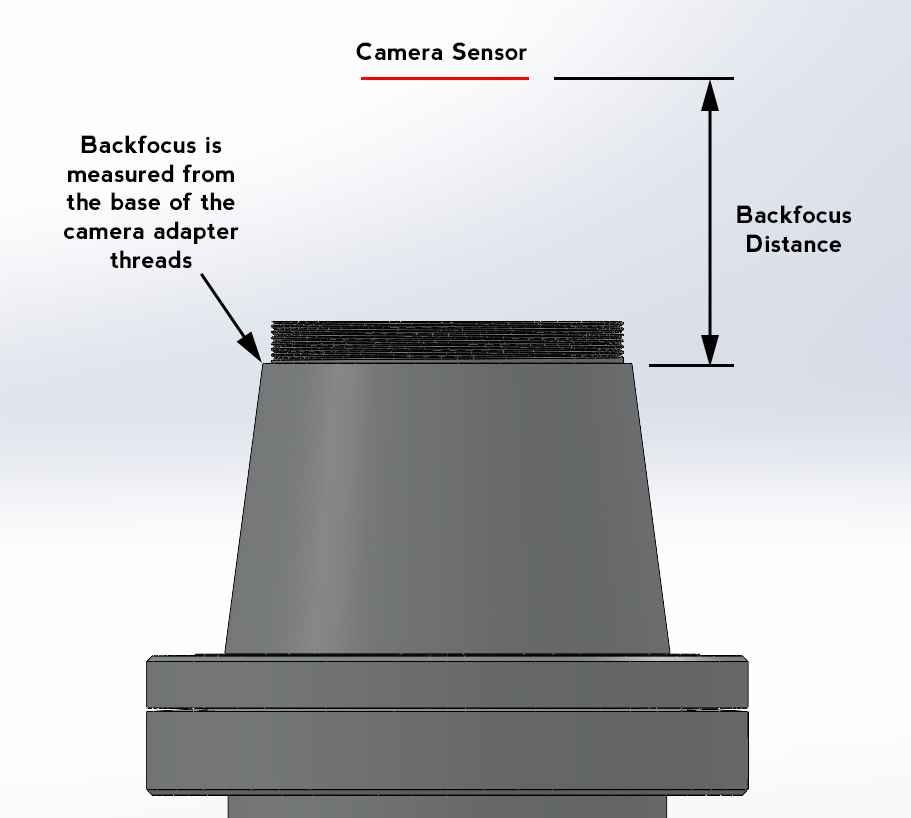
Because HyperStar operates at a very fast focal ratio (approximately f/2), backfocus needs to be especially precise. The faster the focal ratio, the steeper the cone of light reaching the camera, so moving the sensor even a small amount changes where that light comes to focus. For best performance, the camera sensor should be positioned within ±0.5 mm of the nominal backfocus.
Even small spacing errors can affect image quality. Get the backfocus wrong, and trust us…you will know. Elongated stars, poor edge performance, and uneven focus across the field are all signs that the camera is not positioned at the correct distance. In short, your images will be bad. See Troubleshooting & FAQs for examples of how backfocus issues may appear in your images, along with examples of other common problems such as incorrect collimation and tilt.
HyperStar backfocus values
The nominal backfocus values for each HyperStar lens are shown below.
HyperStar Version 4 Model | Backfocus |
|---|---|
C6 | 39.8mm |
C8 | 39.8mm |
C9.25 | 59.7mm |
C11 | 59.7mm |
C14 | 67.4mm |
Note: If you're using a Version 3 or older HyperStar, your backfocus specifications may be different. See the Reference Library for specifications for older HyperStar versions, as well as image comparisons to help you identify which version you have.
Filters and backfocus
The nominal backfocus for each HyperStar model assumes the use of a typical 2" mounted filter. A filter changes the effective optical path length because light propagates differently through glass than through air. As a result, the filter affects the required backfocus even though it does not change the physical spacing between the HyperStar and camera sensor.
By accounting for the filter in the specified backfocus, the HyperStar adapter provides the correct backfocus without requiring the user to add shims or other adjustments to compensate for filter thickness (roughly .7mm, or a third of the filter thickness).
Because the specified backfocus assumes the use of a filter, a filter is required when using HyperStar, even when imaging from a dark-sky location. If light-pollution suppression is not required, a UV/IR or luminance filter can be used to maintain the best optical performance and protect the camera sensor.
For more information about choosing filters for HyperStar, see Filters for HyperStar Imaging.
HyperStar adapters and spacers
HyperStar camera adapters are precisely designed and sized to provide the correct backfocus for the camera configuration they are intended to support. For the most common astronomy cameras, the adapter included with a new HyperStar purchase will be compatible with the camera's specifications.
If your camera has different specifications than the adapter included with your purchase, never fear! We have the right adapter. Starizona offers a myriad of adapters designed for less common camera configurations; if you can think of it, we’ve made it.
And trust us, from experience: the more you try to work things out by adding your own spacers or third-party adapters, the worse things can get. We have an adapter for that!
For more information about selecting the correct adapter for your camera, see Choosing the Right HyperStar Camera Adapter. You can also email us at info@starizona.com if you need guidance choosing the right one. We've got you.
Next article: Achieving Focus