
Filters for HyperStar Imaging
Filters are one of the most effective tools for improving contrast, reducing light pollution, and isolating specific details in astrophotography. Because HyperStar operates at an extremely fast focal ratio (around f/2), filter choice is especially important.
This article explains:
How astronomical filters work
The difference between broadband and narrowband filters
How fast f/2 optics affect filter performance
Recommended filters for HyperStar, starting with one-shot color (OSC) cameras, followed by monochrome/narrowband considerations
Installation details and physical filter placement are covered in the Installation & Setup category.
How astronomical filters work
Astronomical filters work by selectively transmitting certain wavelengths of light while blocking others.
Many sources of artificial light pollution emit light at specific wavelengths, primarily in the yellow and orange portions of the visible spectrum. By blocking those wavelengths while allowing others to pass, filters darken the sky background and increase contrast.
Other filters are designed to isolate very specific wavelengths of light emitted by astronomical objects themselves—most commonly emission from excited gas in nebulae.
Broadband vs. narrowband filters
Broadband filters
Broadband filters transmit a wide portion of the visible spectrum while selectively blocking common sources of artificial skyglow. Because galaxies, star clusters, and reflection nebulae emit light across many wavelengths, broadband filters preserve natural color while improving contrast.
Broadband filters are well suited for:
Galaxies
Star clusters
Reflection nebulae
General deep-sky imaging from light-polluted locations
Narrowband (nebula) filters
Narrowband filters transmit only a small range of wavelengths associated with emission from nebulae.
Most emission nebulae emit strongly at:
Hydrogen-alpha (Hα) – 656.3 nm
Oxygen-III (OIII) – 500.7 nm
Sulfur-II (SII) – 672 nm
By isolating these wavelengths, narrowband filters dramatically increase contrast and block nearly all artificial light pollution. However, they are only effective on emission nebulae, not galaxies or reflection nebulae.
Filters and HyperStar’s f/2 optics
At fast focal ratios, light strikes the filter at much steeper angles than it does in slower optical systems. This changes how the filter behaves: its effective transmission band shifts toward shorter wavelengths, a phenomenon known as bandpass shift or blue-shift. At f/2, this shift can be approximately 2 nm, which is significant for narrowband filters.
This affects both dual-band filters used with color (OSC) cameras and individual narrowband filters used with monochrome cameras. If a filter is not designed for fast optics, its transmission band may partially or completely miss the intended emission line, reducing the amount of signal captured.
For this reason, filters used with HyperStar should either:
Have wider bandpasses to better tolerate the shift, or
Be specifically optimized for f/2 systems, with their transmission bands pre-shifted to compensate for the effect.
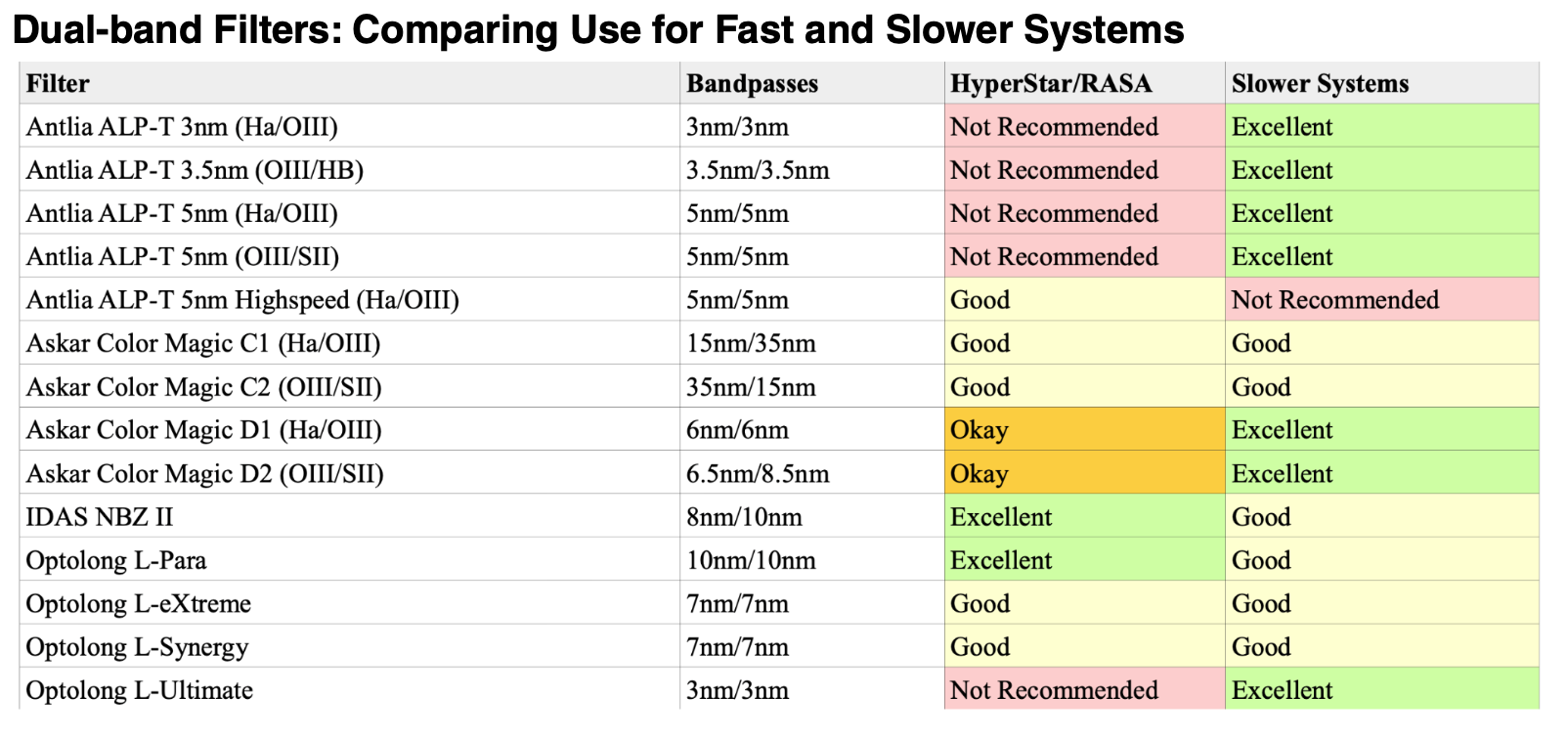
Recommended filters for HyperStar with color (OSC) cameras
One-shot color (OSC) cameras capture color information in a single exposure using a Bayer matrix. Filter selection for OSC cameras focuses on improving contrast while preserving usable color data.
Broadband targets (galaxies, clusters, reflection nebulae)
For broad-spectrum objects, a broadband filter is the best choice.
Recommended filter:
Antlia Triband RGB Ultra II Filter (2" mounted)
This filter performs well from f/2 to f/10, maintains good color balance, and does not produce strong halos with HyperStar. It is an excellent general-purpose broadband filter for OSC imaging.
Emission nebulae (OSC cameras)
For emission nebulae, dual-band filters allow OSC cameras to isolate key nebular emission lines while still producing color images.
Recommended filter:
Optolong L-Para Dual Band Filter (2" mounted)
The L-Para isolates Hα and OIII emission and is designed to perform well at f/2. It delivers clean results with good contrast and minimal halos, making it a reliable choice for HyperStar users with color cameras.
SHO imaging with color cameras (what to expect)
Some users are interested in creating SHO-style (Sulfur-II, Hydrogen-alpha, Oxygen-III) images using a one-shot color (OSC) camera. While this is possible, there are some limitations to be aware of.
There is currently no OIII/SII dual-band filter that we consider an ideal match for HyperStar's f/2 optics. While Antlia offers an f/2-optimized ALP filter for Hα/OIII imaging, they do not currently offer an equivalent OIII/SII version. However, there are some workable alternatives for users who want to approximate SHO-style imaging with a color camera, which we'll cover below.
With OSC cameras, both Hα and SII fall primarily into the red channel of the camera's Bayer matrix, making it difficult to separate the two emission lines using a standard dual-band filter. This is compounded by the fact that SII emission is intrinsically much fainter than Hα or OIII, so obtaining a strong, clean SII signal can be challenging.
There are a few options for users interested in capturing OIII and SII with a color camera:
Askar ColorMagic D2: This is a usable option for HyperStar, with an approximately 6.5 nm OIII band and 8.5 nm SII band. Its relatively wider SII bandpass helps make it more tolerant of f/2 optics, although the resulting SII signal will still be comparatively weak.
Askar ColorMagic C2: This filter has wider bandpasses, but the additional bandwidth also allows more light pollution through. We don't consider it a significant advantage over the D2 for this application.
Dedicated SII filter: For users who specifically want to capture stronger, more isolated SII data, a dedicated SII filter is a better choice than an OIII/SII dual-band filter.
For the latter approach, we recommend the Baader 6.5 nm f/2 Highspeed SII filter. It is specifically pre-shifted for fast optical systems like HyperStar, making it much better suited to f/2 than a conventional narrowband SII filter. It can be used with an OSC camera to collect SII data through the red channel.
The 6.5 nm bandpass is also a good compromise for SII, which is already a relatively faint emission line. Going significantly narrower can make exposure times quite long without necessarily providing a meaningful advantage.
Ultimately, while an OSC camera can be used to build a SHO-style image, monochrome cameras remain the preferred choice for true SHO imaging. Capturing each emission line independently with dedicated filters provides much better separation and control over the final image.
Filters for HyperStar with monochrome cameras
Monochrome cameras capture each wavelength band separately using individual filters. This provides maximum flexibility and is the preferred approach for narrowband and SHO imaging with HyperStar.
Because HyperStar operates at f/2, filter selection for monochrome cameras requires special consideration.
Bandpass shift at f/2
At f/2, narrowband filters experience a measurable bandpass shift, typically around ~2 nm toward shorter wavelengths. While this has little effect on broadband filters, it can significantly impact narrowband imaging if the filter is not designed with fast optical systems in mind.
Very narrow filters intended for slower focal ratios may partially miss—or completely miss—the intended emission line. Filters with wider bandpasses are more tolerant of this effect, while filters specifically optimized for fast systems perform best.
Narrowband filter strategies that work well with HyperStar
There are two reliable approaches to narrowband imaging with HyperStar and monochrome cameras.
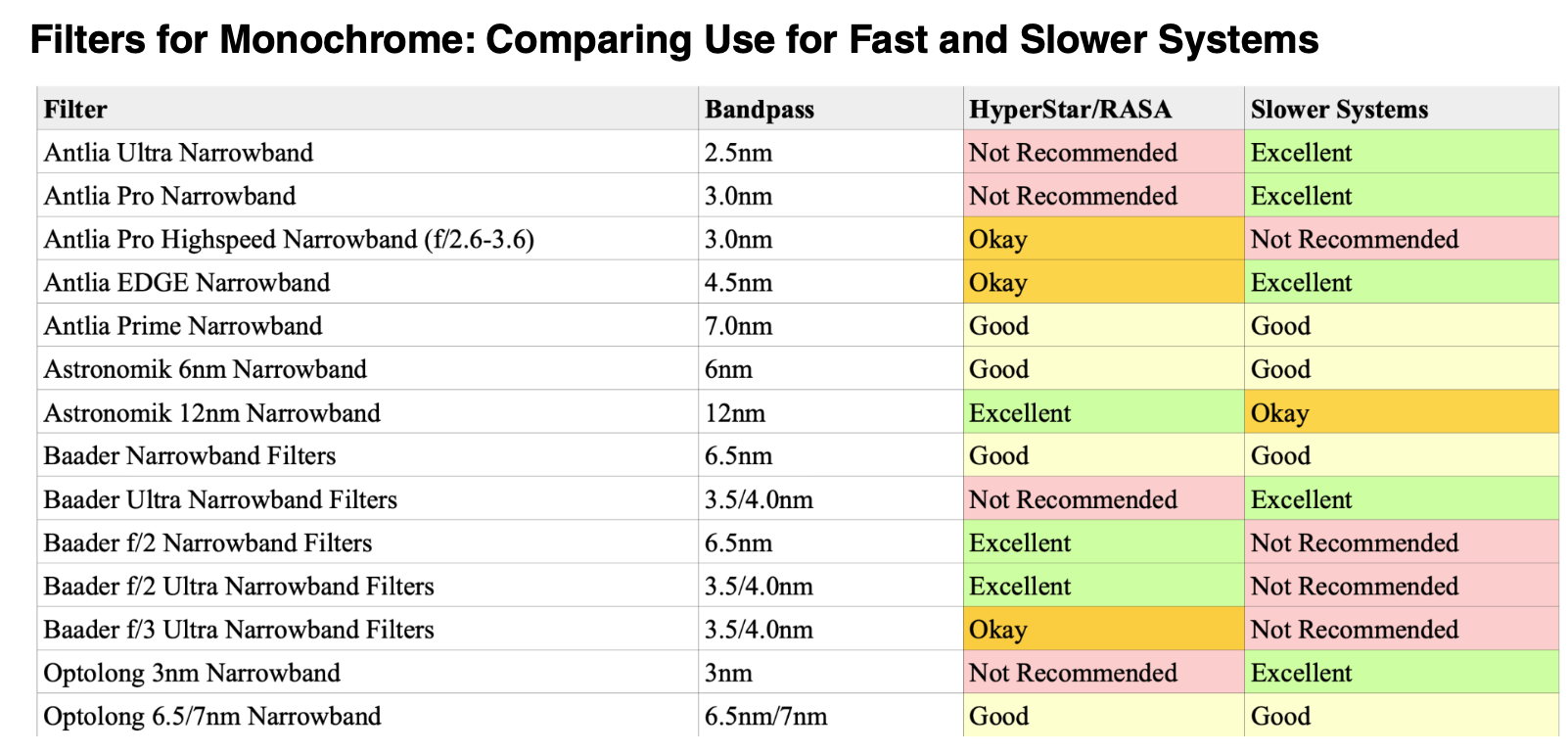
Wider bandpass narrowband filters (approximately 10–12 nm) are more forgiving at fast focal ratios and easier to use, particularly for faint emission such as SII. Because the transmission window is broader, modest bandpass shift does not significantly reduce signal. The tradeoff is reduced contrast and increased transmission of light pollution compared to narrower filters.
Filters around 7 nm also work pretty well with HyperStar, offering a good balance between contrast and signal strength. However, as bandpasses become narrower than 7 nm, throughput begins to decrease significantly, making it more difficult to capture faint emission and potentially requiring much longer exposures.
The second approach is the use of high-speed (f/2-optimized) narrowband filters. These filters are pre-shifted during manufacturing so that when used at f/2, the transmission band lands correctly on the target emission line. This allows the use of narrower bandpasses without losing signal due to bandpass shift.
Recommended narrowband filters for monochrome HyperStar imaging
Baader Highspeed f/2 filters are among the most reliable and well-proven narrowband options for HyperStar.
Baader offers high-speed Hα, OIII, and SII filters specifically optimized for fast optical systems like HyperStar.
The 6.5 nm Highspeed filters provide an excellent balance between contrast, signal strength, and exposure time, and are often preferred for SII due to the faintness of the signal.
The 3.5–4 nm Highspeed filters offer maximum contrast and strong suppression of light pollution and moonlight. These filters work exceptionally well at f/2, though they require longer exposures and careful signal management.
These filters are well suited for both general narrowband imaging and true SHO workflows with monochrome cameras on HyperStar.
Installation Options for Filters with HyperStar
Filters can be used with:
A standard HyperStar camera adapter, or
A filter slider or filter drawer for rapid filter changes
Filter sliders are especially useful when switching between broadband and narrowband filters during a session. Installation and configuration details are covered under Installation & Setup.
A note on filters and HyperStar backfocus
HyperStar backfocus specifications assume the use of a standard mounted 2" filter in the optical path.
In most cases:
No spacing changes are required when adding a filter
Using a filter is recommended even under dark skies
If light pollution suppression is not required, a UV/IR or luminance filter can be used to maintain optical consistency and protect the camera sensor.
Using 1.25" filters
1.25" filters can absolutely be used with HyperStar, especially when paired with smaller sensor cameras. Many imagers already own 1.25" filters before moving to HyperStar, and they can continue using them.
Our filter slider and standard HyperStar adapters are designed to hold 2" filters, so you will need a 2" to 1.25" Filter Adapter to seat a 1.25" filter properly.
With larger sensors, the smaller aperture of a 1.25" filter can cause additional vignetting:
Sensors up to 16mm diagonal: 1.25" filters are generally suitable.
Micro Four Thirds (MFT) sensors (23mm diagonal): Use 36mm unmounted filters or 2" mounted filters.
APS-C sensors (28mm diagonal): 2" filters are recommended.
If you're using a larger sensor, choosing a 2" filter will help avoid additional vignetting caused by the smaller filter aperture.
Next article: Why Collimation Matters with HyperStar